

Functionally Inspired: Stories Behind the Object
Phillips Memorial Library Archives and Special Collections team collaborated with Providence College Galleries to create this inspired exhibit.
This exhibit will be on display now through Spring 2027. Located on the second floor of the Phillips Memorial Library.
Stories Behind the Object
This exhibition explores the creative translation of art across mediums. How do you take something 2D and make it 3D? Providence College professor Judd Schiffman and his students explored this question through a ceramics assignment, selecting artists and paintings to investigate deeper symbolic themes that inspired the teapots on display.
Rather than merely copying artworks, students translated these paintings into a completely different visual language, reimagining texture, form, and composition, through clay. PC students were invited to think like designers, sculptors, engineers, and storytellers all at once. They got to explore deeper themes, such as the cycles of nature and overcoming fear, which helped bring the components of the teapots together. Each element of the teapot led to the creative reimagining of the painting, reminding us that inspiration is not about imitation, but transformation and reenvisioning. Assignments such as this can help students stretch their limits not only artistically, but intellectually and symbolically as well.
In the teapots on display, Providence College ceramics students, inspired by the work of Yayoi Kusama, David Hockney, and Philip Guston, took on the challenge of transforming two-dimensional paintings into functional, three-dimensional forms.
Functionally Inspired: Stories Behind the Object, curated by Amie Bah ’27, is a project of Case Studies, a Providence College Galleries initiative that showcases research-based projects focused on objects from the permanent collection or the campus community.
Special thanks to Michelle Chiles, Rebecca Docter, Nichole Speciale, Carol Stakenas, the Art and Art History Department, and Phillips Memorial Library, Archives and Special Collections.
About the Artists
Yayoi Kusama
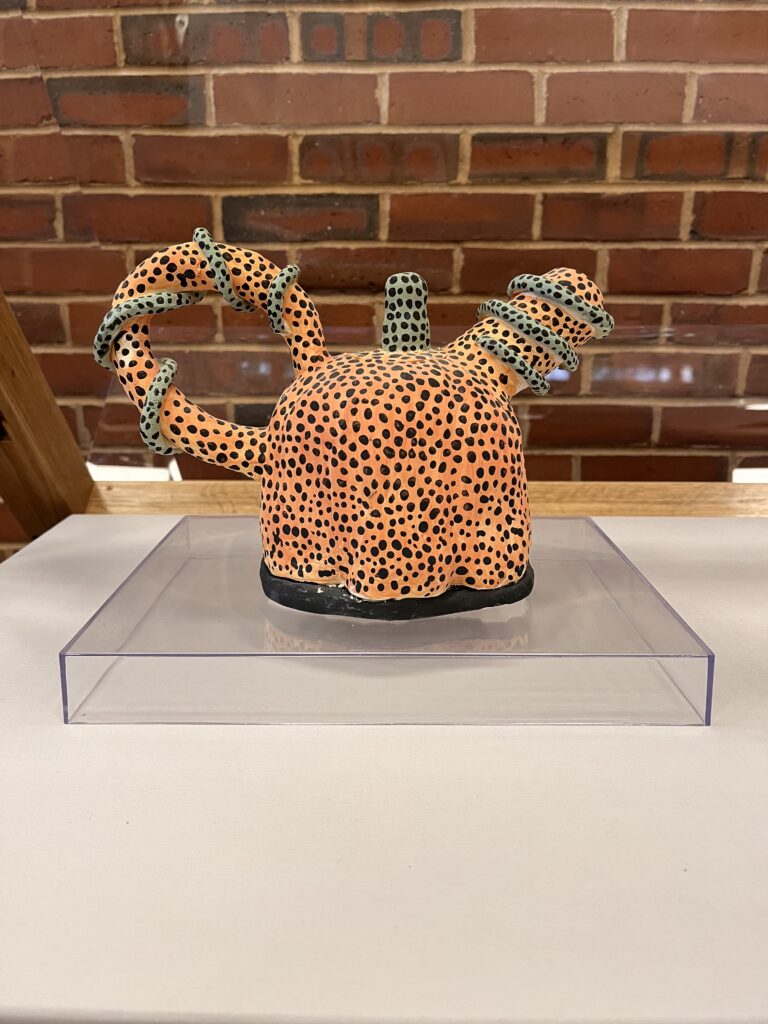
Yayoi Kusama’s work is known for its vibrant repetition, polka dots, and pumpkins. These motifs were inspired by visual hallucinations she had experienced since childhood. While many of these visions were frightening, pumpkins became something that could inspire comfort, resilience, or hope.
Inspired by Kusama’s alchemy of experiences, this teapot was turned into a pumpkin, showing how a functional object can also carry deep meaning. The pumpkin’s sturdier shape, size, and handle invite both comfort and stability to the pot’s functionality. The muted orange color and the green color can invoke different emotions for the user, such as warmth or growth. An everyday ritual has the possibility of invoking certain energies, hopes, and perhaps a moment of calm.
David Hockney
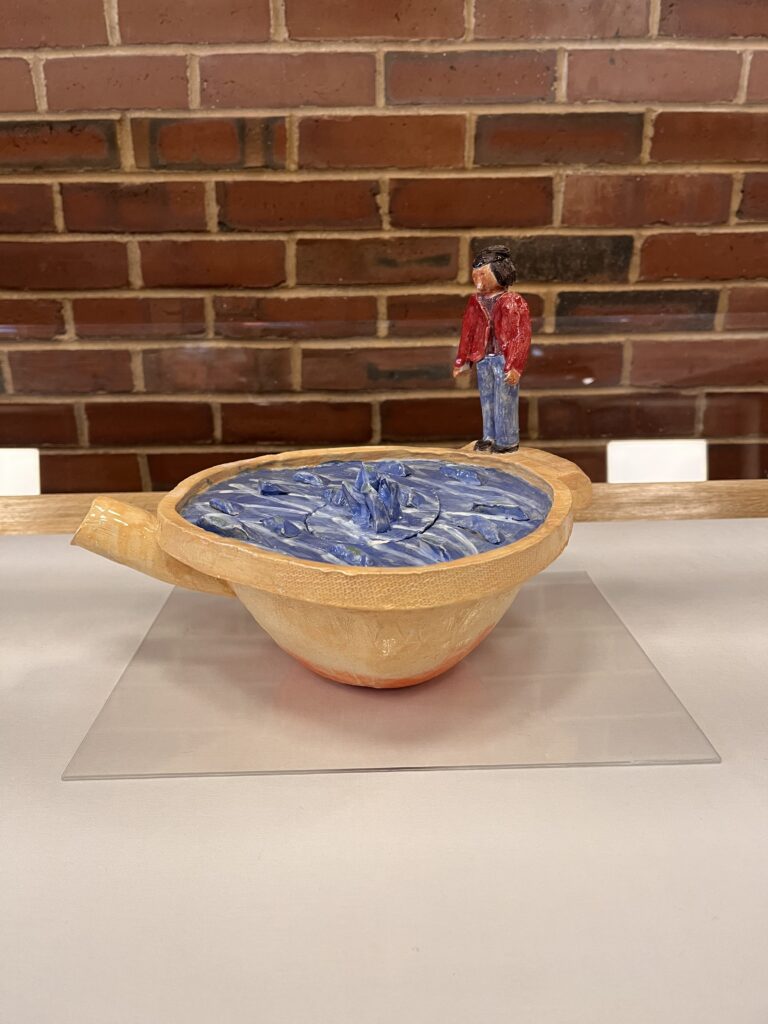
David Hockney’s A Bigger Splash and Portrait of an Artist (Pool with Two Figures) (1972) explores perspective, emotion, and the visual complexity of water. Fascinated by translating these ideas into clay, the student reimagined the swimming pool and turned it into the teapot’s bodily form.
The surface of the water became the lid, and the man looking into the pool became the handle itself. The man who was swimming in the painting’s pool is not physically seen in the teapot, but his essence and activity are inferred by the lid’s placement. This allows him to become one with the water or the tea (literally). These intentional placements bring to life the themes of emotional/physical closeness and distance that Hockney exhibited in his painting.
Philip Guston
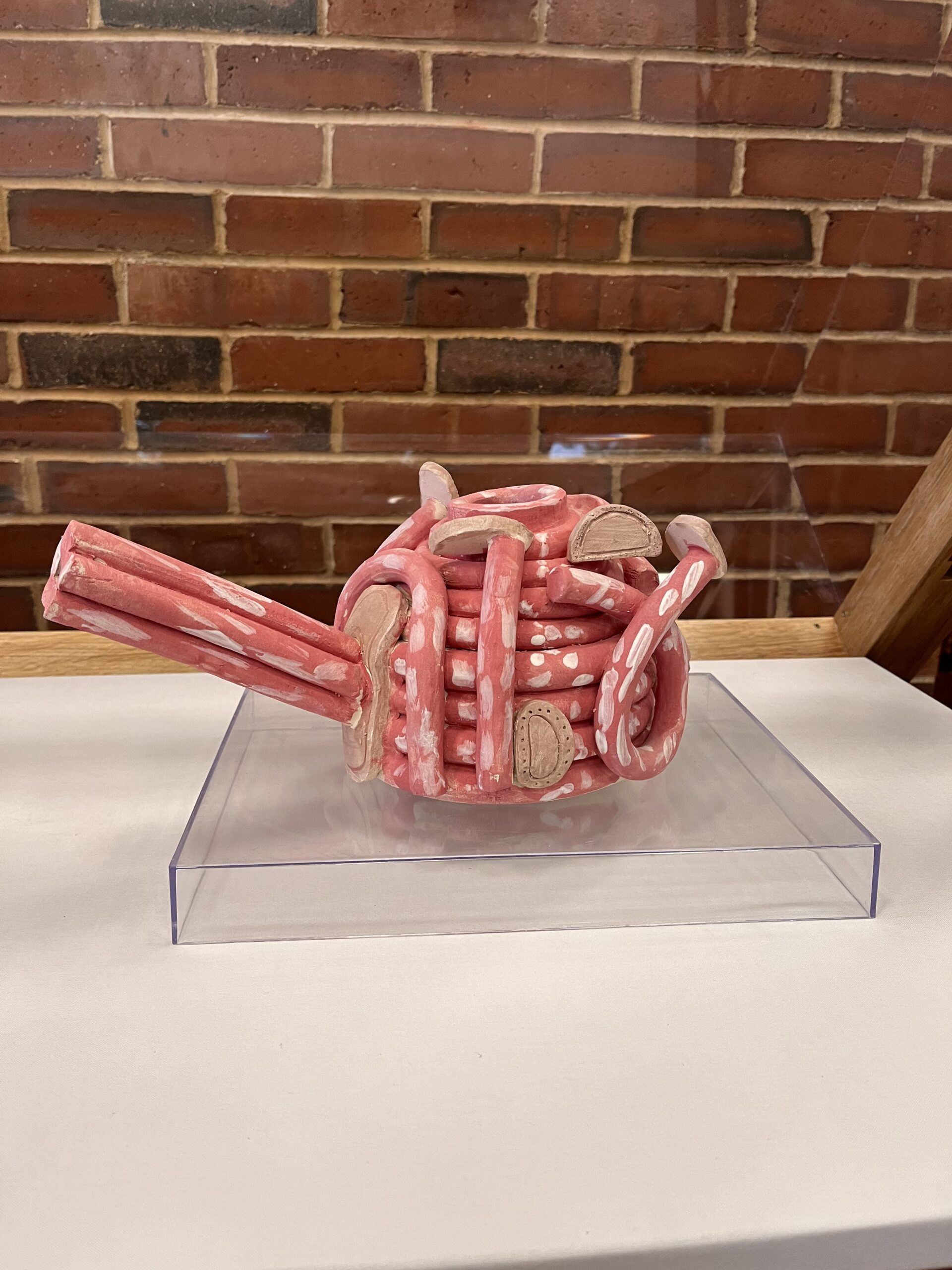
This teapot reimages Philip Guston’s Floor (1976). Here, similar muted red and brown colors are used. But compositionally, the pile of cartoonish, jumbled-up legs and shoes are transformed. Instead of showing the inferred knees and legs from the painting, those coil spirals become one with the teapot. The texture of the spirals becomes smoother too, almost like the tea itself. The brown “shoe” at the base of the teapot, and the spout existing as tube-like coils honor the theme of the mass of legs Guston famously painted about.
Want to learn more about the artists who inspired the teapots on display? Check out the book table text to the exhibit, or explore a few below:
by Marco Livingstone
Guston in time : remembering Philip Guston
by Ross Feld 1947-2001., Philip Guston 1913-1980.
by YK PRESS
Documenting Providence College: Ceramics
In addition to the student-curated Case Studies project, the PC Archives and Special Collections (ASC) has curated a complementing exhibit entitled Documenting Providence College: Ceramics which draws from the college records collections to highlight the history of the ceramics unit of the Art and Art History department at PC.
This exhibit features photographs of students and faculty at work in all stages of making pottery from wedging and forming clay, to firing in outdoor kilns, to the glazed final pieces. The documents on display tell part of the history of the Art and Art History department, which you can read more about on the department’s history page.
The PC ASC also holds collections of Fr. John J. Sullivan, O.P. and Fr. Lawrence M. Hunt, O.P. who both played vital roles in bringing art and art history to campus.
For questions about the Providence College Archives and Special Collections, our exhibits, or to make an appointment, contact us at pcarchives@providence.edu or 401-865-2578.